
Sustainability
Initiatives for Environment and Safety
Environment and Safety Management
The Central Glass Group has established the Environment, Safety and Health Guidelines as a guideline for Our Values and Responsibilities based on the Central Glass Group Corporate Philosophy: the safety-related principle, "We place top priority on safety in our work and strive to improve our own health," and the environmental principle, "We contribute to the protection of the global environment by actively addressing environmental issues."
Based on the Environment, Safety and Health Guidelines, each organization's environment, safety and health policy is determined.
Guidelines for Environment, Safety, and Health
The Central Glass Group, as part of the Responsible Care Initiative, shall ensure environment, safety, and health compliance in all processes from development to manufacturing, logistics, use, final consumption, recycling, and disposal with the sincere cooperation of each and every employee. The Group shall announce the achievements and engage in dialogue and communication with society
| Management system | Compliance | Accurately understand and comply with the details of laws and regulations. |
|---|---|---|
| Continuous improvements | Engage in activities based on rules such as regulations and standards and strive for continuous improvement. | |
| Prevention and risk treatment | Try to prevent problems from occurring and, if a problem should occur, make efforts to prevent a recurrence by analyzing the root cause appropriately. | |
| Confirm the conformity, validity, and efficacy of each requirement through regular audits and investigations and take appropriate action if necessary. | ||
| Environmental protection | Understand the influence that activities related to all processes from development to manufacturing, logistics, use, final consumption, recycling, and disposal have on the environment and promote the reduction of their environmental impact. | |
| Process Safety and disaster prevention | Secure a working environment that enables employees to work safely and ensure the safety and security of the local community by making efforts to prevent accidents and disasters such as fire, explosions, and chemical spills. | |
| Occupational health and safety | Endeavor to eliminate potential dangers in the working environment and promote activities that lead to the support and maintenance of mental and physical health, in addition to promoting activities to protect one’s own life, body, and health. | |
| Distribution safety | Comprehensively promote safe logistics to protect safety of employees, forwarding agents, pickup and delivery service providers, and the environment by managing the means of transportation, transportation status, and safety information, and making efforts to broadly communicate measures in the event of an accident. | |
| Chemical substance management | Protect the safety of all operators, including our customers and the environment, by understanding the danger and toxicity of chemical substances and managing and handling them properly. | |
| Communication | Announce the details of our activities and achievements and actively engage in dialogue with all stakeholders. | |
Environment and Safety Management Promotion System
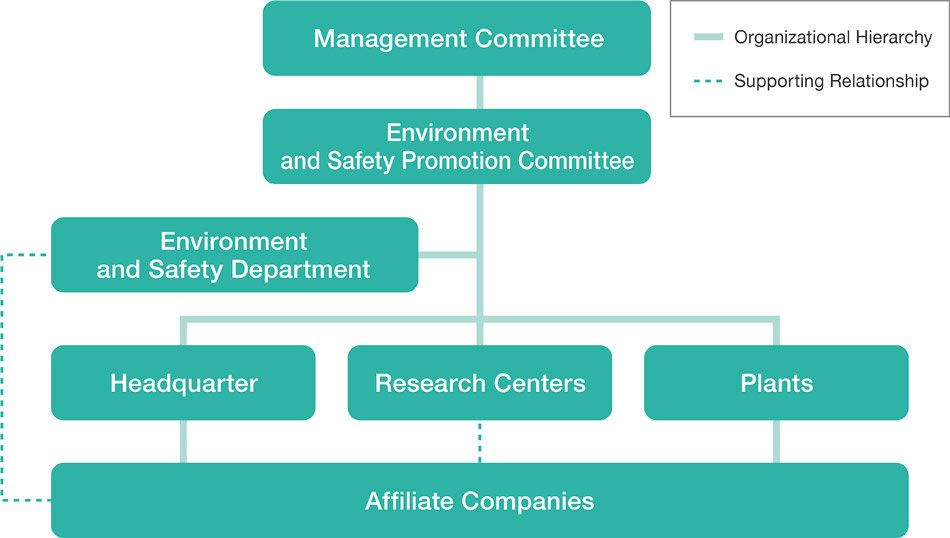
The Central Glass Group has established the Environment Safety Promotion Committee, and the Environment and Safety Department acting as its secretariat is promoting Group-wide environment and safety efforts. The head office, research centers, plants and affiliate companies incorporate items unique to each business site into a specific activity plan and engage in environment and safety initiatives.
Improving Energy Use Efficiency
Material Balance of the Central Glass Group
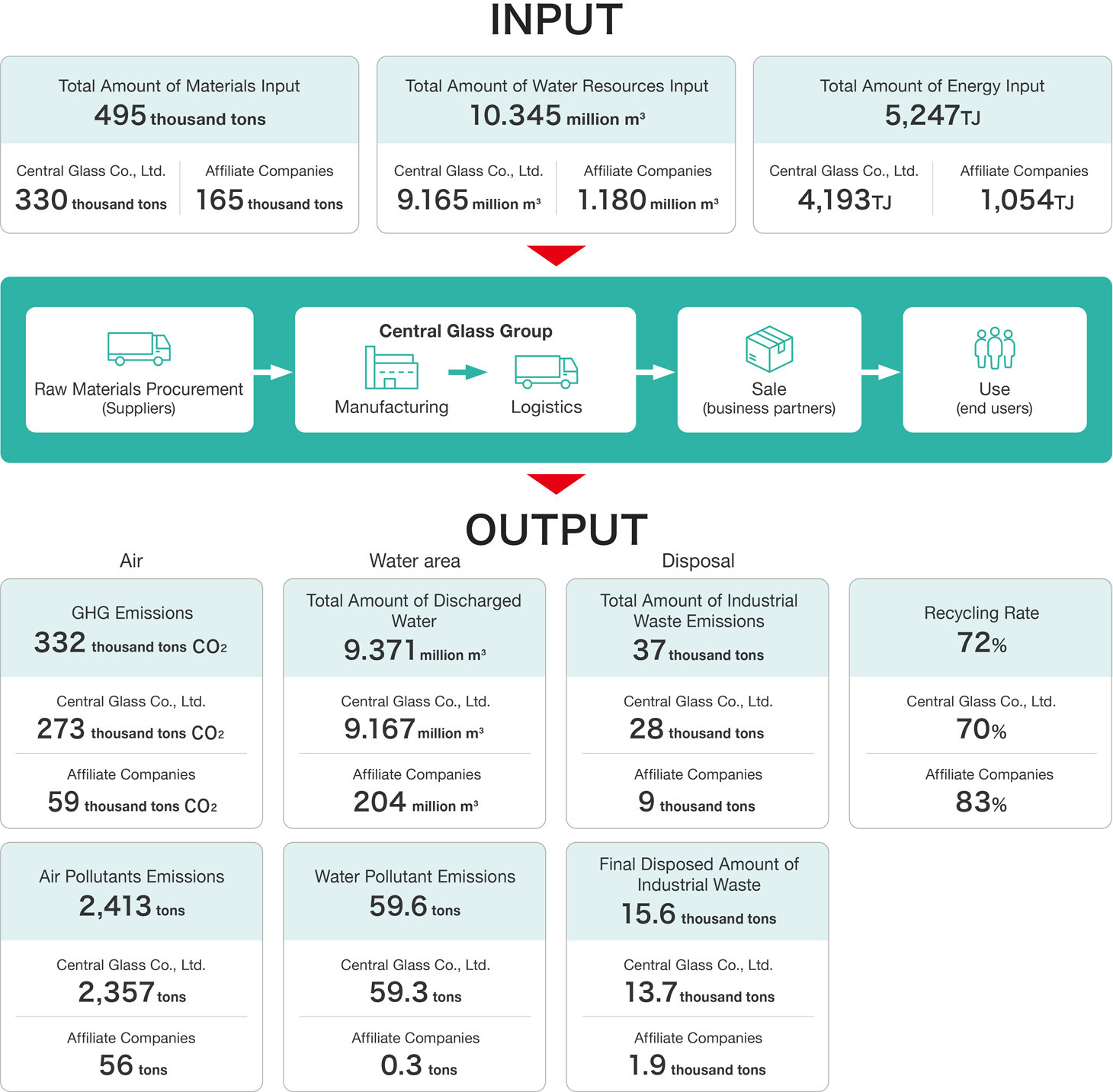
The Central Glass Group continues its efforts to reduce the environmental impact of production activities by carefully monitoring the amount of energy and resources used in our production activities as well as the environmental impact they generate. These efforts primarily focus on reducing emissions of greenhouse gases (hereinafter referred to as GHG) and discharge of environmentally hazardous substances into the air and water, as well as on recycling waste and reducing the final disposed amount. We will continue to monitor our resource consumption and amount of waste to further control generation, emissions and discharge of GHG, environmentally hazardous substances, and waste, as well as promote cyclic use to build a recycling-oriented society.
Reduction of GHG Emissions
Medium- and Long-Term Targets
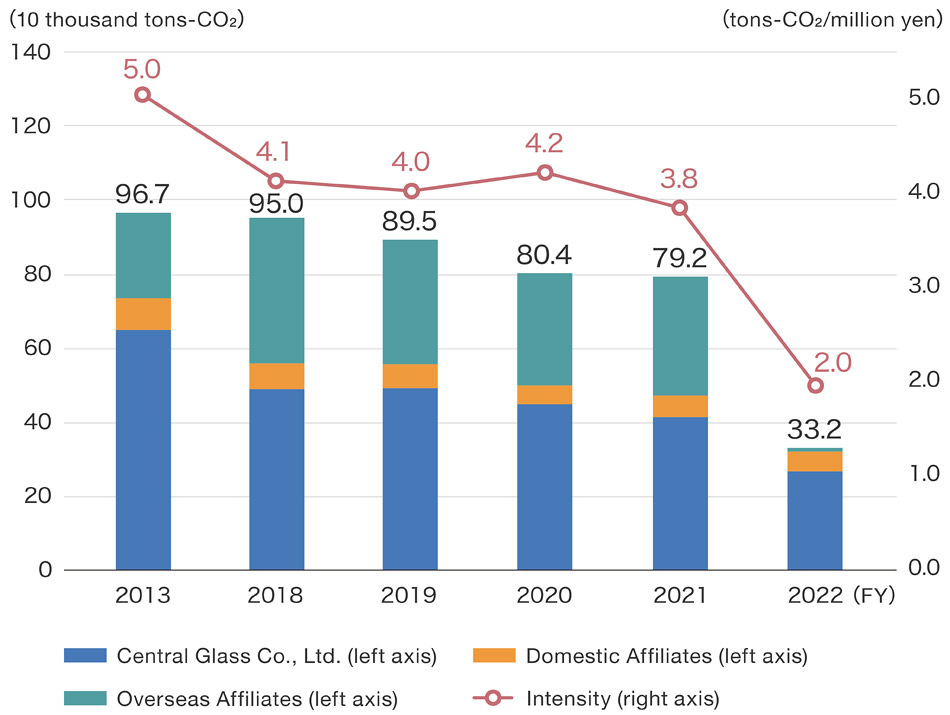
Reduce total Scope 1 and 2 GHG emissions for the entire Group by 60% from the FY2013 level by FY2030
Challenge to realize net-zero GHG emissions in 2050
Carbon Neutrality Initiatives
FY2024 emissions in Scope 1 and 2 totaled 316,000 t-CO2 due to factors such as changes in the production mix for chemicals.
Emissions totaled 748,000 t-CO2 after structural adjustment, which excludes emissions from transferred European and U.S. Automotive Glass business, etc. from the FY2013 emissions results, a 57.8% reduction in FY2024 emissions versus FY2013.
The Group has been undergoing third-party verification of Scope 1 and 2 GHG emissions since FY2024, and will continue efforts to reduce GHG emissions and environmental impact, while striving to make highly reliable information disclosure.
Air Pollutant Emissions
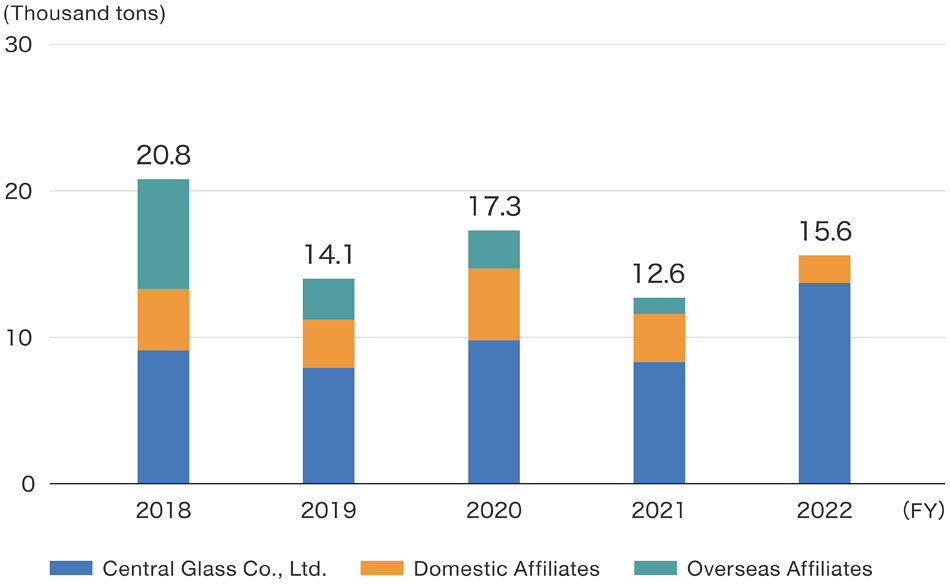
Our Group monitors the concentration and amount of sulfur oxides (SOx), nitrogen oxides (NOx), soot and dust, and other air pollutants emitted, in accordance with the Air Pollution Control Act, the laws and regulations of each country, and the emission standards of the regions where our facilities are located. Some plants have installed environmental protection equipment such as desulfurization equipment for SOx, catalytic adsorption equipment for NOx, and electrostatic precipitators for soot and dust to recover air pollutants before they can be discharged into the atmosphere. Our air pollutant discharge decreased in FY2024 from the previous year. We will continue to carry out appropriate management reliably.
Effective Use of Water Resources, Water Pollutant Discharge, Identification of Water-Related Risk Areas
See Integrated Report, Page 54
Reducing Waste
See Integrated Report, Page 55
Transitioning to a Circular Economy
Recovering and Recycling Calcium Fluoride (Fluorite)
The Group applied our long-developed fluorochemical technologies to expand our business into fine chemicals, our current core business. Fluorite, the raw material for hydrogen fluoride, is a natural resource with limited production countries and reserves. To this end, Central Glass developed a recycling technology to recover fluorine as fluorite from fluorine-containing waste liquid discharged during manufacturing processes. We use part of this recovered fluorite as a raw material for our hydrogen fluoride, effectively using resources and reducing waste. We also applied our expertise in developing recycling technologies to begin using the fluorite generated from fluorine-containing waste liquids generated at our suppliers and other companies. In fiscal 2024, we set a quantitative target for the circular economy: “Doubling the amount of recycled fluorite used in the production of hydrofluoric acid by fiscal 2030 (compared to fiscal 2020).“We will strive to achieve a circular economy through efforts to increase the ratio and amount of recycled fluorite used.
Occupational Health and Safety, Safety and Disaster Preparedness, and Chemical Substance Management
Occupational Health and Safety, Safety and Disaster Preparedness , Chemical Substance Management
Addressing Climate Change Issues
1. Basic Approach
The Group views addressing climate change issues as one of our materialities. To this end, we address climate change impacts on our business in accordance with the Task Force on Climate-related Financial Disclosures (TCFD) framework. We are committed to our efforts to reduce GHG emissions and address other climate change-related initiatives while gradually expanding our disclosures to enhance corporate value.
2. GHG Emissions Trends
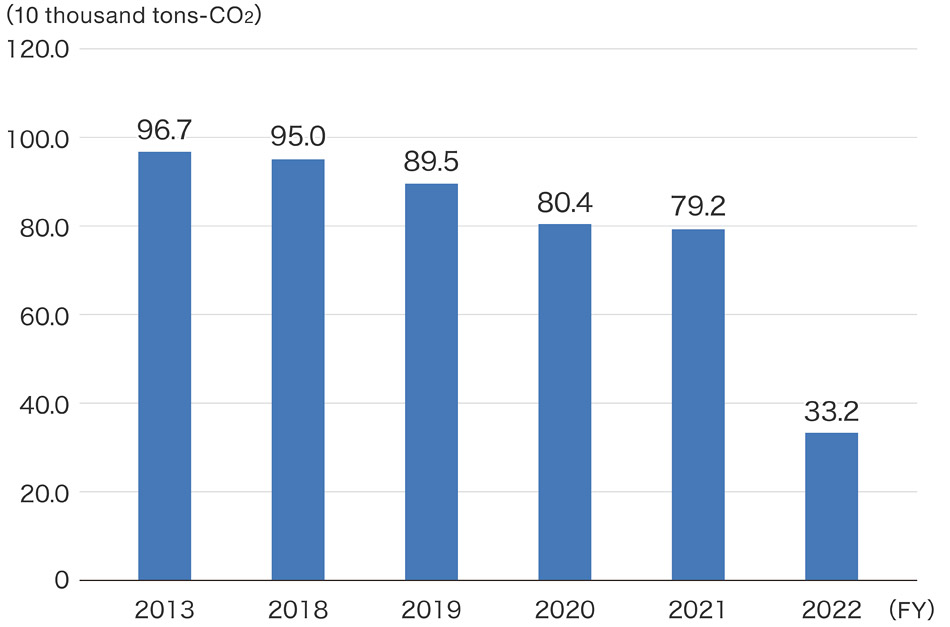
GHG Emissions Data
(10,000 t-CO2)
| 2013※ | 2020 | 2021 | 2022 | 2023 | 2024 | FY2030 Target | |
|---|---|---|---|---|---|---|---|
| Scope1 | 60.2 | 37.1 | 34.6 | 21.4 | 23.5 | 20.9 | ― |
| Scope2 | 14.6 | 14.5 | 13.8 | 11.8 | 12.2 | 10.7 | ― |
| Scope1+2 | 74.8 | 51.6 | 48.3 | 33.2 | 35.7 | 31.6 | 29.9 |
| Reduction Ratio Compared to the Base Year | ― | -31.0% | -35.4% | -55.6% | -52.3% | -57.8% | -60% |
- GHG emissions minus GHG emissions in the base year of the transferred European and U.S. automotive glass operations, etc.
3. Disclosure based on TCFD recommendations
Governance
The Management Committee serves as the decision-making body for business execution, discussing and approving initiatives to address climate change and other environmental and social issues in the Group. We also established the Sustainability Committee to analyze and evaluate our efforts to address each issue across the organization. This committee also discusses individual policies and measures as necessary, reporting and proposing the discussion results to the Board of Directors as appropriate. The Board of Directors discusses and supervises Group responses to environmental issues, our progress, and other areas in response to discussions and recommendations made by the Management and Sustainability Committees.
Strategy
The Group has taken the following initiatives to understand the impact of climate-related risks and opportunities on our business and has announced their results.
- Identify climate-related risks and opportunities
- Assess impact, period, and likelihood of occurrence for each risk and opportunity
We have conducted a new quantitative assessment of the identified risks and opportunities that can be modeled to estimate financial impact, and have examined and organized our response strategies based on this assessment.
Transition risks refer to risks associated with the transition to a low-carbon society. We quantitatively assessed these by aggregating the increased operating costs associated with higher carbon prices.
Physical risks refer to risks associated with natural disasters directly caused by climate change. We recently conducted hazard screening (river flooding, inland water flooding, storm surge, water stress, heat waves, and sediment disasters) to identify potential risks due to climate change at our group's major business locations, and conducted a quantitative assessment to estimate the financial impact on locations assessed as having a certain level of flooding hazard.
Climate-related opportunities refer to business opportunities presented by addressing climate change and the transition to a low-carbon society. We quantitatively assessed the increased revenue opportunities from the growing demand for the products our group sells that contribute to decarbonization.
The results of the quantitative assessment of the above risk and opportunity items and the relationship between the response strategies and indicators and targets based on these results are shown in the table on the following.
| Period | Short-term: around 3 years | Medium-term: until 2035 | Long-term: from 2036 |
|---|---|---|---|
| Likelihood of Occurrence |
|
|
|
| Degree of Impact (Sales) |
|
|
|
| Degree of Impact (Costs and Profits) |
|
|
|


Main Reference Scenarios
Below 2°C Scenario: International Energy Agency (IEA), World Energy Outlook 2023 (WEO 2023), Announcement Pledge Scenario (APS), Network for Greening the Financial System (NGFS) Version 4, Below 2°C Scenario
4°C Scenario: Intergovernmental Panel on Climate Change (IPCC) Sixth Assessment Report (AR6)
Impacts of Climate-Related Risks and Opportunities
| Areas | Major Factors | Business Impacts | Period | Likelihood of Occurrence |
Financial Impacts | Degree of Impact | |
|---|---|---|---|---|---|---|---|
| Transition Risks | Regulations | Stricter carbon pricing and other GHG emission regulations | (Own emissions) Increase in operating costs due to higher carbon prices |
Medium term |

|
Increase in manufacturing costs |

|
| (Upstream supply chain emissions) Rising raw material and fuel prices due to rising carbon prices |
Medium term |

|
Increase in manufacturing costs |

|
|||
| Stricter energy conservation laws and regulations | Increase in procurement of renewable energy (wind, solar, etc.) due to Scope 2 reduction requirements | Medium to long term |
|
Increase in manufacturing costs |
|
||
| Increase in equipment renewals, investments, etc. | Medium to long term |
|
Increase in manufacturing costs |
|
|||
| Technologies | Changing customer expectations | Shift in demand to products with higher environmental performance from other companies | Medium to long term |
|
Decrease in sales |
|
|
| Progress toward a low-carbon economy | Increase in R&D expenses and capital expenditures to develop products with higher environmental performance | Medium to long term |
|
Increase in R&D expenses and capital expenditures |
|
||
| Reputation | Changes in investor evaluations | Increase in financing costs resulting from our declining ESG reputation | Medium term |
|
Increase in financing costs |
|
|
| Physical Risks | Acute | Increasing and intensifying storms, floods, and other weather disasters |
Damage to work sites and operation suspensions Operational suspension due to damage to logistics networks, substitute product procurement, loss of sales opportunities due to damage to sales partner companies |
Short to medium term |
|
Occurrence of recovery costs, decrease in sales |
|
| Chronic | Heat waves and chronic rising temperatures | Heat stress, reduced operating capacity due to increased infection risk, lost sales opportunities | Short to medium term |
|
Decrease in sales |
|
|
| Increase in electricity consumption for air conditioning, increased maintenance due to equipment breakdowns, etc. | Short to medium term |
|
Increase in manufacturing costs |
|
|||
| Increased drought due to low rainfall | Decrease in operating capacity due to increased water stress (shortages and deteriorating quality), lost sales opportunities | Short to medium term |
|
Decrease in sales |
|
||
| Climate-Related Opportunities | Products and Services | Stricter refrigerant regulations | Increase in demand for refrigerant application products (HFO) with low GWP | Medium to long term |
|
Increase in sales |
|
| Growing demand for products with high energy-saving performance | Increase in demand for insulation foam products (HFO) | Medium to long term |
|
Increase in sales |
|
||
| Increase in demand for heat-insulating and heat-shielding glass | Medium to long term |
|
Increase in sales |
|
|||
| Growing demand for energy efficiency using IoT | Increase in demand for process and cleaning gases for semiconductor equipment due to rising demand for semiconductor products | Medium term |
|
Increase in sales |
|
||
| EV market expansion | Increase in demand for electrolytes due to rising demand for lithium-ion batteries | Medium to long term |
|
Increase in sales |
|
Quantitative assessment of Key Risks and Opportunities, Response Strategies, Indicators and Targets
| Key Risks and Opportunities | Scenario | Financial Impacts | Response Strategies | Indicators and Targets | |||
|---|---|---|---|---|---|---|---|
| 2030 | 2050 | ||||||
| Risks | Transition | Increase in operating costs due to higher carbon prices | NZE※1 (1.5°C) |
Approx. 6.1 billion yen※3 (increase in costs) |
Approx. 7.2 billion yen※3 (increase in costs) |
|
By FY2030, 60% reduction in Scope 1 and 2 (vs. FY2013) By FY2050, net-zero in Scope 1 and 2 |
| Physical | Damage and loss of sales opportunities due to damage to the Company's factories caused by typhoons, flooding, etc. | RCP8.5※2 (4°C) |
Negligible | Less than 0.1 billion yen※4 | Minimize damage and ensure business continuity in the event of a large-scale disaster | ー | |
| Opportunities | Expanded revenue opportunities through increased demand for products that contribute to decarbonization (low-GWP/ energy-efficient products) | NZE※1 (1.5°C) |
Approx. 87.0 billion yen※5 (increase in sales) |
Not assessed |
|
GHG emissions avoided by providing environmentally friendly products※6 5,800,000t-CO2 (FY2027) |
|
- Scenario to achieve net zero emissions (NZE) by 2050: Standard scenario to stabilize global average temperature at 1.5°C above pre-industrial levels.
- Scenario corresponding to maximum greenhouse gas emissions in 2100.
- Calculated based on US$140/t-CO2 (2030) and US$250/t-CO2 (2050) for developed countries and estimated emissions at each future point in time (Scope 1 and 2).Calculations are on a consolidated basis.
- Financial impact of climate change on flood damage due to river flooding and storm surges.(Reference value) Cumulative amount for the period up to 2050: Approx. 200 million yen.
- Total increase in sales of products contributing to decarbonization (low-GWP refrigerants, low-GWP blowing agents, high-insulation glass, semiconductor process materials, and battery electrolytes for EVs).
- Based on the GHG emissions reduced at the use stage of the final products that use our environmentally friendly products. Avoided emissions are estimated using our unique formula to calculate reduced emissions through one year of use based on Company sales volume.
Introducing an Internal Carbon Pricing System
The Central Glass Group introduced an Internal Carbon Pricing (ICP) system in June 2023 as part of our efforts to achieve our GHG emissions (Scope 1 and Scope 2) reduction targets. This system uses an internal carbon price to visualize carbon costs for use in capital investment decision-making.
We are committed to investing in reducing emissions to meet the growing demand for GHG reductions.
Reference: Internal carbon price (at introduction) of 10,000 yen/t-CO2
Risk management
Each business unit identifies and assesses operational risks and impacts, reporting them to management as needed. The Sustainability Committee also shares, analyzes, and evaluates business risks, opportunities, and countermeasures related to climate change and other factors across the organization. The committee then reports and makes proposals to the Board of Directors as necessary.
We launched the target management framework for medium- to long-term GHG emission reduction in FY2023. This framework addresses Scope 1 and 2 emissions, striving to achieve our 2030 target and 2050 net zero GHG emissions target. We consider this framework important to our activities to reduce GHG emissions. The main initiatives of the framework include estimating future emissions, evaluating the possibility of achieving targets, formulating action plans to reduce emissions, and revising such plans as necessary.
Indicators and Targets
- Aim to reduce group-wide GHG emissions (Scope 1 and 2), including overseas companies, by 60% by FY2030 compared to FY2013 levels
- Aim for net zero GHG emissions by 2050
- GHG emissions avoided by providing environmentally friendly products 5,800,000t-CO2(FY2027)
Third-Party Assurance
The Central Glass Group has obtained third-party assurance regarding the appropriateness of the disclosed data on GHG emissions (Scope 1 and 2) of Central Glass and its three major subsidiaries for fiscal year 2024 and onward.
| Data | FY2024 | |
|---|---|---|
| GHG (Greenhouse Gas) Emissions (t-CO2e) | Scope1 (t-CO2e) |
206,049 |
| Scope2 (t-CO2e) |
89,985 |
|
| Total Scope1 and 2 (t-CO2e) |
296,034 |
|
1. Reporting period
April 1, 2024 to March 31, 2025
2. Scope of reporting
Central Glass
Head Office, Ube Plant, Kawasaki Manufacturing Site of Ube Plant, Chemicals Production Engineering Center,
Research Centers (Kawagoe City, Saitama; Ube City, Yamaguchi; Matsusaka City, Mie; Fujisawa City, Kanagawa)
Group Companies
Central Glass Products (Matsusaka Head Office and 4 other sites)
Central Glass Fiber (Matsusaka Plant, Kasugai Plant, and 1 other site)
Central Chemical (Ube Plant and 4 other sites)
3. Standards for calculating Scope 1 emissions
CO2 emissions from fuel:
We use the following standards to calculate this.
Japan’s Act on the Promotion of Global Warming Countermeasures (Global Warming Act)
The Ministry of the Environment’s Greenhouse Gas Emissions Accounting and Reporting Manual (GHG Manual)
HFC emissions:
We use the following standards to calculate this.
Global Warming Act, GHG Manual
CO2 emissions from carbonates:
We use the following standards to calculate emissions from carbonates during glass manufacturing and neutralization.
Global Warming Act, GHG Manual
Note that Scope 1 also includes CO2 emissions from non-fuel sources.
4. Standards for calculating Scope 2 Emissions
CO2 emissions from the generation of purchased electricity:
We use the following standards to calculate this.
Global Warming Act, GHG Manual
For electricity supplied in Japan, we set supplier-specific adjusted emission factors for each business site, using the latest emission factors data announced by the Ministry of the Environment and Ministry of Economy, Trade and Industry.
CO2 emissions from external heat:
We use the following standards to calculate this.
Global Warming Act, GHG Manual